
Most landing pages are built to convert — and built in a way that makes them almost invisible to Google. They are short, they hide behind a campaign, and they disappear when the campaign ends. But a landing page can also be the opposite: a page that ranks on Google month after month and keeps bringing leads while you sleep. The difference is not luck. It is a deliberate decision, made before you design a single section.
If you are new to the concept, start with what a landing page is and what it is for in my guide (in Spanish) qué es una landing page. Here we go one step further: how to make that page show up in search results.
Quick answer: Landing page SEO means building a landing page that Google can find, understand and rank — not just one that converts ad clicks. Decide first whether the page is for a short campaign (keep it out of Google) or an evergreen offer (optimize it to rank). If it should rank: one page, one keyword, one intent; keyword in the URL, title and H1; enough helpful content below the conversion block; fast on mobile; and internal links from your site. The 10-step checklist below covers each point.
What Is Landing Page SEO?
Landing page SEO is the practice of optimizing a landing page so that it ranks in organic search results, instead of depending only on paid ads, social media or email to receive traffic.
It works differently from regular page SEO in three ways. First, a landing page has one single goal — one offer, one action — while a normal website page can inform, navigate and sell at the same time. Second, many landing pages are temporary: they live and die with a campaign, so ranking them makes no sense. Third, there is a permanent tension between conversion and content: conversion advice says «say less, remove distractions», while Google needs enough substance to understand what the page is about and why it deserves to rank. Landing page SEO is the art of solving that tension instead of choosing a side.
The First Decision: Campaign Landing Page or SEO Landing Page?
Before optimizing anything, decide which of the two types your page is. Trying to make one page serve both purposes at once is the most common reason landing pages fail at both.
| Aspect | Campaign landing page | SEO landing page |
|---|---|---|
| Traffic source | Paid ads, social media, email | Organic search (Google) |
| Lifespan | Days or weeks, while the campaign runs | Months or years (evergreen) |
| Indexing | Often set to noindex on purpose | Indexed and meant to be found |
| Content | Minimal: headline, benefits, form | Complete: answers the searcher’s questions |
| Goal | One conversion, right now | Rank first, convert over time |
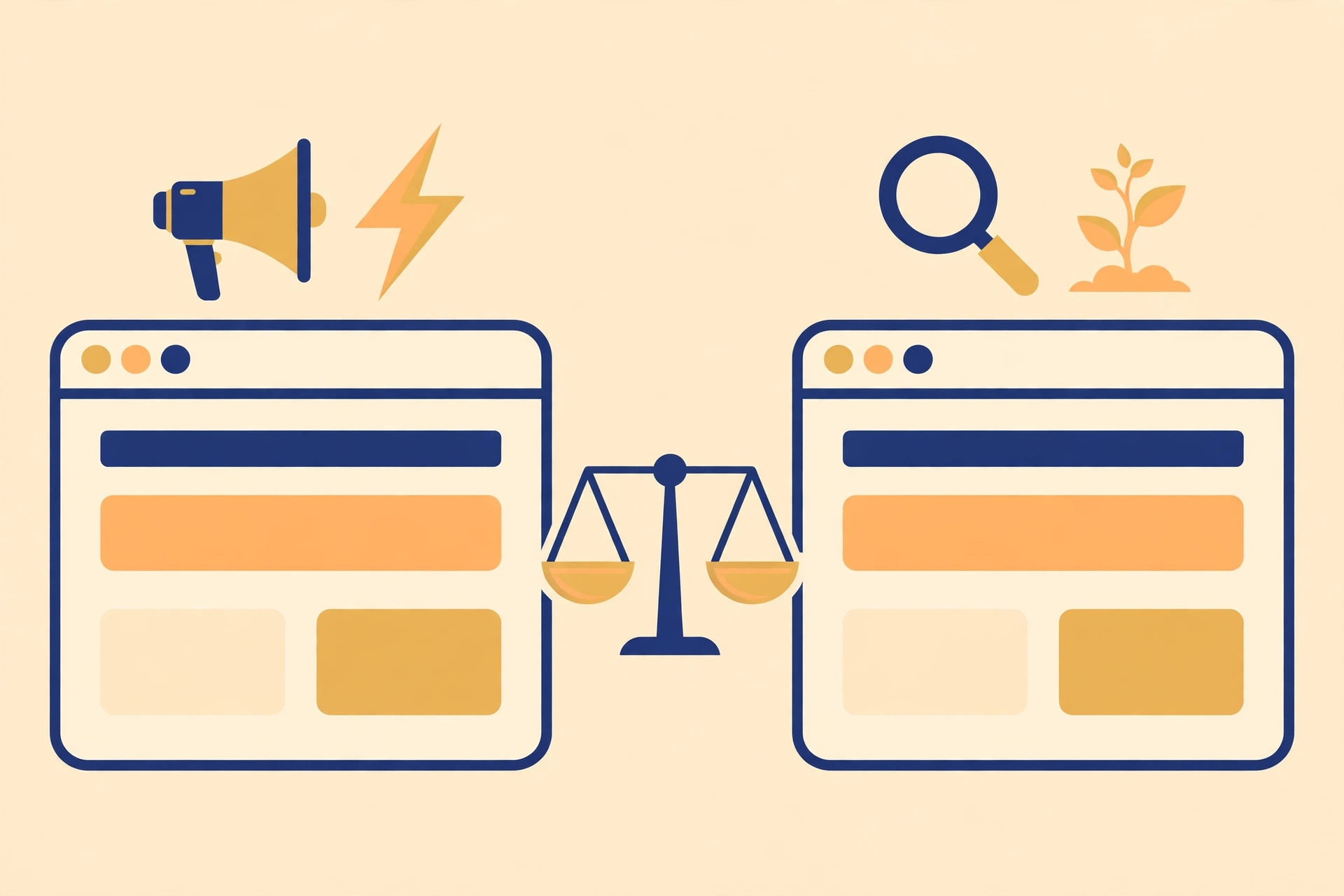
My rule as a designer: my campaign pages and my thank-you pages stay out of Google on purpose — they are steps in a funnel, not content. But the landing pages I build for evergreen services and offers are SEO landing pages: they are designed to rank, and they are the ones I optimize with everything in this guide.
Can a Landing Page Actually Rank on Google?
Yes — and you have probably clicked on many without noticing. Every service page that appears when you search for something like «landing page design» or «plumber near me» is, in practice, an SEO landing page: one page, one offer, ranking for one clear search.
A landing page ranks when it meets the same conditions as any other page, adapted to its format:
- The offer behind it is evergreen — it will still exist in six months.
- Real people search for it with a clear intent.
- The page is indexable and Google can crawl it.
- It contains enough substance to answer the search better than the pages already ranking.
- Other pages (yours and others’) link to it.
If any of those fail — a two-week offer, a page set to noindex, three lines of text and a form — ranking is not a realistic goal, and that is fine: that page belongs to the campaign type.
Landing Page SEO Checklist: 10 Steps to Rank and Convert
1. Choose one keyword and one search intent
An SEO landing page targets one keyword — the exact thing your ideal client types into Google — and answers one intent. If the keyword promises a service, the page sells that service; if it promises information, the page informs. Mixing intents («rank for everything about my business») is how pages end up ranking for nothing. Start from the search, not from your offer menu.
2. Put the keyword in the URL, the title tag and the H1
These are the three signposts Google reads first. Keep the URL short and readable (for example, /landing-page-design/), write a title tag that includes the keyword and a reason to click, and use one single H1 that says what the page offers. One H1 per page: your section headings are H2 and H3, not decoration for bigger fonts.
3. Add enough content — below the conversion block
This is where the conversion-versus-SEO tension gets solved. Keep the top of the page exactly as conversion practice demands: clear headline, benefit, call to action, form. Then, below that block, give Google (and the careful reader) the depth it needs: how it works, what is included, who it is for, proof, and a FAQ section. Pages that rank and convert use this order all the time — the pitch first, the substance right after. For layout ideas, see my collection of landing page examples and the breakdown of landing page ideas by industry.
4. Structure the page with clear headings
Headings are the table of contents Google uses to understand your page. One H1, H2 for the main sections, H3 for sub-points, in order. Write them as answers to what the searcher asks — «What’s included», «How it works», «Pricing», «Questions» — instead of clever slogans nobody searches for.
5. Make it fast and mobile-first
Most searches happen on phones, and a slow landing page loses the visitor before the headline loads. Compress your images, avoid heavy page builders stacking scripts you do not need, and test the page on a real phone, not just in the editor preview. Speed is a ranking factor and a conversion factor at the same time — one of the few optimizations that helps both sides.
6. Earn internal links from your own site
A page nobody links to is a page Google assumes is not important. Link your SEO landing page from related blog articles, from your services menu and from your homepage where it fits naturally. In my case, my articles about landing pages point to my service page, and the service page points back to the most useful guides. Internal links are fully under your control — use them before chasing backlinks.
7. Optimize your images like text depends on them
Give image files descriptive names (landing-page-seo-checklist.webp, not IMG_2041.png), write honest alt text that describes what the image shows, and keep file sizes light. Images are content Google reads, not decoration — and they can bring their own traffic from image search.
8. Add trust signals and answer real questions
Rankings bring strangers; trust converts them. Show who is behind the page (a real name and face, in my case), testimonials or results where you honestly have them, and a visible way to contact you. End with a FAQ section answering the questions clients actually ask you — it serves the reader, and it is the kind of content Google loves to quote.
9. Decide the indexing on purpose — never by accident
Check that your SEO landing page is set to index, and that your campaign and thank-you pages are set to noindex. I have seen both mistakes: a great service page hidden from Google for months by one forgotten setting, and private thank-you pages indexed and appearing in searches. Two minutes in your SEO plugin’s settings per page prevents both.
10. Keep the page fresh
An evergreen page is not a finished page. Update your examples, replace old screenshots, adjust prices and dates, and re-read the page when your offer changes. A landing page that still says what you sold two years ago will slowly slide down the results — Google notices, and so do visitors.
5 Landing Page SEO Mistakes That Keep You Invisible
- Setting every landing page to noindex «just in case». That setting is for campaign and thank-you pages. Applied to an evergreen service page, it deletes you from Google completely.
- Duplicating the same page for every keyword or ad. Ten near-identical pages compete with each other and none of them accumulates enough strength to rank. One strong page per intent beats ten copies — for duplicates in general, the same logic applies to design mistakes I covered in my article about landing page mistakes (in Spanish).
- Publishing a form with almost no text. A headline, an image and a form give Google nothing to understand or rank. Thin pages are campaign tools; they are not SEO.
- Building it with the slowest tool available. A gorgeous page that takes eight seconds to open on a phone will not hold a ranking — or a visitor.
- Confusing an ads page with an SEO page. If the page exists for a two-week promotion, do not judge it by rankings; if it exists to be found on Google, do not judge it only by this week’s conversions. Different jobs, different metrics.
Landing Page SEO vs. Regular Page SEO
The fundamentals are the same — intent, content, speed, links — but the constraint is different. A blog article can explore a topic freely; an SEO landing page must answer the search and move the reader to one action, without navigation menus or side paths that leak the conversion. That is why the structure in step 3 matters so much: conversion block first, depth below. And it is why a landing page is usually built in a full-width template, while articles live in your blog’s normal layout. If you are building yours in WordPress, my tutorial (in Spanish) cómo hacer una landing page en WordPress walks through the technical setup step by step.
My Approach as a Designer
On my own site I keep the two types strictly separate. Campaign pages and thank-you pages: noindex, out of search, doing their funnel job. Service and evergreen offer pages: those are my SEO landing pages, and each one targets the keyword its client actually searches. It is slower than running ads — and it keeps working when the ads stop. If you want a landing page built this way from the start, that is exactly what my landing page design service does: designed to convert, and built to be found.
Frequently Asked Questions
Can a landing page rank on Google?
Yes, if the offer is evergreen, people search for it, the page is indexable, it has enough helpful content and other pages link to it. Service pages that rank for searches like «landing page design» are SEO landing pages in practice.
How long should an SEO landing page be?
Long enough to answer the search completely — usually longer than a campaign page. Use the conversion block first (headline, benefit, call to action) and add depth below: how it works, what is included, proof and FAQs. There is no magic word count; completeness beats length.
Should I noindex my landing pages?
Only the campaign and thank-you pages. An evergreen landing page that you want Google to rank must be indexed. The mistake is leaving the setting to chance: decide for each page, on purpose.
Do landing pages need backlinks to rank?
For low-competition searches, good internal links from your own site can be enough. For competitive keywords, external backlinks help like they do for any page — but start with internal links, because you control them and they are free.
Can I use the same landing page for ads and SEO?
You can send ad traffic to an SEO landing page, and it often converts well. The reverse — expecting a short campaign page built only for ads to rank — rarely works. Build for SEO first if the offer is evergreen; then use the page for both.